I live a seven-hour drive from Denver. There's an airport near me, but the flights are expensive and frequently delayed or cancelled, so when I have to go to Denver, I drive.
A seven-hour drive can be rough... unless it looks like this:
My drive takes me up into the headwaters of the San Juan River, over the continental divide, and into the headwaters of the Rio Grande, Arkansas River, and South Platte River. People go out of their way to vacation in the places that I have to drive through to get to Denver.
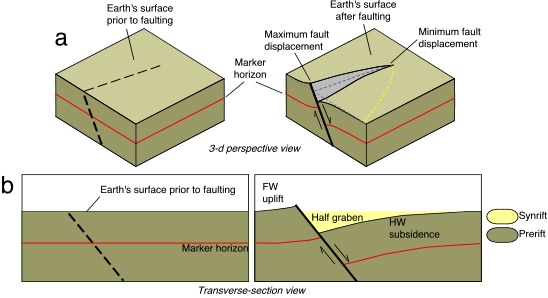
The photo is of the northern Sangre de Cristo mountains, on the eastern side of the Rio Grande Rift. The peaks are Precambrian igneous and metamorphic rocks, sillimanite grade and partially melted - I did my senior thesis research in the area. Further to the south, the Precambrian is covered by layers of sedimentary rock, all tilted towards the east, away from the fault. The range front is a normal fault, possibly still active. The valley is filled with sediments: lots of alluvial fan gravels, interbedded with lake sediments from wetter times. The western side of the valley is much less dramatic: hills of Tertiary volcanic rocks from the San Juan field are partially buried by the young gravels. Streams in the area feed an artesian groundwater system - as I drove across yesterday, I could see crusts of white minerals on the soil, left behind from evaporation of standing water. The Great Sand Dunes National Park is along the range front - the sand is carried into the valley by streams, and then blown back along the valley by the prevailing west winds. It's a particularly beautiful example of a half graben.
There was a session (that I missed, unfortunately) on groundwater and tectonics of the Rio Grande Rift. It focused more on the Albuquerque area (for good reason: there are a lot of people using that groundwater down there); the abstracts for the session are here.
I love that valley. High, open, dry. Snow-capped peaks. And a little bit of tectonics, where North America has been pulled a little bit apart, west of the plains and east of the Colorado Plateau.
Wednesday, October 31, 2007
GSA: getting there is half the fun

Sunday, October 28, 2007
GSA: everyday science
There are stories about a session at the American Geophysical Union in 1966, when it finally became clear to the audience that sea-floor spreading was real and that the continents really did move. Apparently some other recent AGU meetings have had that sort of feel in sessions about climate change - Chris Mooney describes one in Storm World. But the Geological Society of America meetings that I've attended... they just haven't been like that.
Every talk is fifteen minutes long. Fifteen minutes, in which to make a case that one's ideas or data should change the way we interpret things. Fifteen minutes to convince a room of structural geologists that we really should start with equations of conservation of momentum, as Dave Pollard tried this afternoon. Fifteen minutes to try to explain why rotations determined from paleomagnetic data don't fit those predicted from estimates of strike-slip motion along Laramide structures. (If the model never fits the interpretations of the field data, something's got to be going on - either we don't understand the structures, or we don't understand what kind of rotation the structures should cause.) It's enough time to raise a few questions, maybe even to make a well-constructed argument... and then it's on to the next.
In part, it's the nature of science: most of what we do is incremental, fitting new data into existing models, tweaking the ideas here and there when the data don't quite fit with previous understanding. In part, it's the way the talks work: they are progress reports, ways to raise questions before submitting the long version of the research for rigorous peer review.
So what's the most interesting thing I saw today? Well, there was one talk (in a structure modeling session) testing a hypothesis for entraining layers of debris in the toe of a glacier... which concluded that, no, thrust faults couldn't form in a glacier. (It's nice to see someone come to a conclusion that, no, a model doesn't work.) And I learned, little by little, about mechanical modeling - but I didn't come away with the conclusion that my explanations for a certain group of structures have been totally wrong all this time.
My biggest conclusion for the day is that I need to do a better job of teaching quantitative skills in structural geology. Which isn't really a new conclusion at all.
But perhaps that is not so unsual.
And maybe, if I had wanted to have some paradigms shifted, I should have sat in the Mars sessions. (There will be another one tomorrow. I'm going to go, at least for a while.)
Friday, October 26, 2007
Pre-GSA Public Service Announcements
First, one future announcement: the Cutting Edge people are planning a follow-up session to the Teaching Structural Geology and Teaching Petrology workshops at the Rocky Mtn/Cordilleran Section GSA meeting (March 19-21 in Las Vegas). The abstract deadline in Dec. 11. The session isn't on the GSA website yet - look for it after the national meeting is
done. Oh, and there will probably be an associated field trip. I'm looking forward to the opportunity to discuss how to teach Cordilleran structure!
Now, about GSA...
Geoscience Educators Social Reception
Saturday, 27 October, 2007
5:00 - 7:00 pm
Colorado Convention Center, Hall F
Geobloggers dinner?
We tentatively planned to meet Sunday after the opening reception. I don't know the time or place. Sports bars may be rather crowded Sunday night...
World Series
If you've got a hotel room and a late plane flight, make sure to contact your hotel. Don't let your hotel room get given away to a baseball fan...
GSA. Be there.. or be a cricket fan, I guess. (I was going to say "or be a Yankees fan," but we can't all be originally from New England and currently from Colorado, and perfectly willing to switch allegiances depending on quality of the pitching on any given night. :D )
And with that, I've got a long but beautiful drive to make, and way too many exams to grade. Hope to see some of you in Denver.
Monday, October 22, 2007
Links: drought in Turkey & SE US, Tambora, visualizing climate change
Some links to things I've been reading (and thinking about for classes):
RealClimate has a guest post from Figen Mekik about climate change and drought in the Mediterranean. It's a great combination of a personal perspective (Mekik is originally from Turkey) and explanation of the processes involved. In particular, Mekik explains the North Atlantic Oscillation, which I've always found confusing... but which is kind of an Atlantic version of El Nino, and which can have an important impact on weather in Europe, North Africa, and North America.
John Fleck has been watching the drought in Georgia and blogging about what the historical record shows. Is the problem with climate, or with population growth, in this case? (The definition of drought, after all, depends on how much water a given area needs.)
For anyone who, like me, needs a good source of images for climate change lectures: the global warming art site. I recognize the graphs from the peer-reviewed literature (and the wiki pages associated with them have all the references). And it's really nice to have access to the graphics in color, and in an easy format for importing. (Thanks to Michael Tobis and John Fleck for the links.)
And, finally, remembering "the year without a summer" and the eruption of Tambora. I heard the story on NPR this morning while I was driving in. In 1816, people starved in Europe, and New England had snow in the middle of the summer... all because of the eruption of a volcano on the other side of the world. Tambora's eruption was bigger than Krakatoa's (which also had a cooling effect later in the century). (Thermochronic had a great post about Tambora, as well, and connected it to the writing of Frankenstein and with landscape paintings.)
Friday, October 19, 2007
Teaching: where did that water come from?
I've just started the water section of my intro class. Like usual, I asked students to raise their hands if their water came from a well, and raise their hands if it came from a reservoir, and so forth. Fewer than half the students responded in any way at all, even when I asked how many of them just get water from a tap.
It's not that uncommon. ("Trace the water you drink from precipitation to tap" is one of the questions on the old bioregional quiz... and it's asked, I think, because so few people actually know.) But this year, I responded a little differently. I told the class to go home and find out, and I would put an extra credit question on the weekly quiz.
And they did it.
It would have been pretty easy to cheat on the question, you know. I know where my local water comes from, but the students all come from different places. And a few students simply answered "a reservoir." But the vast majority of them told me more - much more. They told me where they were from. They told me the names of reservoirs and the rivers that they dam. They told me how far the community well was from their house. They told me that their wells hadn't gone dry, although the neighbor's wells have. One even told me about the Ogalalla aquifer.
I'm delighted. And I think they're ready, now, to talk about groundwater next week.
(And this, of course, is the real reason that I use extra credit: because sometimes students will take the opportunity and run with it.)
Interesting post about Japan earthquake early warning system
Sismordia has posted a really interesting description of Japan's earthquake early warning system. At the end, she asks for comments:
Call for comments: Are you living in Japan, or do you know people who are? Have you (or they) had to react to an Earthquake Early Warning yet? If so, please let me know how it worked, what went through your mind, what you did to prepare for the shaking, how you felt afterwards.
I'm curious, too, so if you know anyone who has experienced the system, please go over to her blog and describe your experiences.
Teaching with An Inconvenient Truth
I'm showing An Inconvenient Truth in class the week after next, while I'm away at the Geological Society of America meeting. I'm going to leave the class with questions to answer while I'm away. But... what should I ask?
I've used climate change to discuss the intersections between science and public policy before. I used to show What's up with the Weather?, a NOVA/Frontline documentary made after the Kyoto Accord was signed, but before the 2000 election. By 2004, it felt really dated, in part because of the four years of the Bush administration, and in part because study after study after study had come out showing that climate is changing now. So when An Inconvenient Truth came out on DVD last fall, I bought it and immediately showed it in class.
But I think I need a different approach to the discussion for the two videos. What's up with the Weather explained the science behind the greenhouse effect (and did a very nice job, I thought - there was a particularly good demonstration of the absorption of infrared radiation by CO2), but it also gave a fair amount of time to climate skeptics, and to people who had a variety of different views about what we should do, if anything. So I asked students to watch for the answers to a number of factual questions (such as what the greenhouse effect is, and what kinds of climate proxies can be used to infer past climate conditions, and what sorts of positive and negative feedback mechanisms can affect global temperature changes), and then I spent the discussion time talking about how to interpret media discussions of science. (We brainstormed lists of facts vs testable hypotheses vs opinions - I wanted them to leave the discussion ready to critically evaluate what they are told.)
That approach won't work for An Inconvenient Truth. In many ways, the movie is a piece of rhetoric... but it's rhetoric based on pretty solid science. (There's been a lot discussion lately about the UK court finding nine errors in the movie, and fortunately there are also some good discussions that evaluated the science behind nine points. Deltoid summarizes the response of a number of different climate scientists; RealClimate's summary is here.) And at the same time, it isn't hard to find critiques of the movie - try the Wall Street Journal's editorial page, for instance.
So I want students to think critically about everything that they hear and read. But, on the other hand, I don't want to encourage students to parrot the climate denialists - I want them to think about the science, about what's happened with CO2 and about the different sorts of effects that it can have.
So... any ideas about what I should do, or what kinds of questions I should ask? Should I ask about specific key points, to reinforce them? (I would love to send the students to the peer-reviewed literature to have them see what the experts really say. Unfortunately, our library is very limited - if it's not in Nature or Science, the students will have trouble finding it - and I think the students need somebody to translate scientific language for them. And if I send them to the web in search of more info, how will I make sure they are looking at reliable sources, and not climate-denial blogs? I don't want them to get in the habit of evaluating on-line sources by choosing ones that agree with their preconceived notions.)
(I do have another idea. I'm considering giving a pre-test and a post-test, same questions, and seeing if An Inconvenient Truth leaves the students with an improved understanding of climate change. One reason: I showed the movie to a math-phobic friend, and she said that she had never understood graphs before watching the gimmick with Al Gore on the lift. And that made me wonder if Gore explained the science more clearly than scientists had... which is the real reason why I show the movie in class.)