There was an article in the New York Times last week about students' grade expectations. (Summary: student expect high grades, especially if they feel that they worked hard. Professors disagree.) Much commentary ensued, at the NYT, in academic blogs, like Female Science Professor, and in my work e-mail.
Like most professors, I think my grades mean something. Exactly what depends on the class. Usually the grade says something about my confidence that the student will be able to use the concepts and skills from the class in future work, either in classes, research, or a job. But then there are general education classes, where the students could be anything from future geologists to future teachers to people who will need to live on this planet for the rest of their lives - I'm less confident that my grading methods match my goals for all of those students. But I keep trying.
I've never had a student formally challenge a grade in one of my classes, but every semester I've got students who do poorly on the first exam or paper, and want to do better on the next ones. And that's where it gets tough: if hard work isn't enough for a good grade, what kind of advice do you give to a student who wants to do better?
Like most professors, I suspect, I've got quite a collection of ideas about how to study effectively, and how to get better at doing things that aren't easy. Sketch and label diagrams from the textbook or lecture. Write definitions of unfamiliar words. Get together with friends and explain things to one another. Try to write questions that I might put on an exam. Etc., etc., etc. But they don't always work.
I heard an incredibly depressing geoscience education talk at last fall's GSA (McConnell, 2008). Dave McConnell had students report the strategies they used for studying in their intro class, and coded them as "rehearsal" (such as re-reading notes or the textbook), "elaboration" (such as many of my suggestions, I think - writing definitions or labeling sketches), and "organization" (such as outlining or categorizing material). And the correlation to class performance? None. (Well, except for one outlier, who did nothing and got a grade of 20 or so on the exam.) All of the students preferred to use the easier study strategies (such as reading notes or memorizing terms), and disliked the more difficult ones (such as drawing pictures or writing summaries) - the students who did well in the class didn't use the more challenging strategies any more than the struggling students did. Nothing seemed to help - some students just did well, and some students did poorly.
When I came home from the meeting, I graded my intro class's first exam, returned it, and told the students who got D's or F's to come talk to me. And then I had no idea what to tell them. I had just heard this talk that showed that effort had no effect on mastery of the course material, and there I was, trying to tell students how to study for their next test. What was I going to say? "You know, when I took tests, I just re-read my notes, took the test, and got an A. Except for math classes - I never studied for them at all. So good luck, and I have no idea what I'm talking about - and I'm not sure the geoscience education researchers know, either." No way. I teach certain material, give certain assignments, and put specific questions on tests because I think they're important, either as life skills or as knowledge about the world we live on. I want the students to do well enough to get A's or B's, not because it would make us all feel better, but because if they don't, they've missed something worth knowing.
I gave the students the same advice. And met with some of the same students after the second exam, to keep brainstorming new strategies for learning.
I hope that somebody does a study that focuses on struggling students, because I want to know what strategies help people learn better. I don't want to be a gate-keeper, separating students who would succeed no matter what they did from students who aren't going to make it. I want to help people get over barriers, or open doors, or... well, pick your metaphor. This planet is too cool and too important for geology to be restricted to those that learn it easily.
Saturday, February 21, 2009
Hard work, grades, and study strategies

Saturday, November 8, 2008
Geoblogger meet-up at AGU?
Lee Allison asked if there is going to be a geoblogger meet-up at AGU. I know that Christie and Brian are going to be there, and I think Ron is organizing a session and Julian submitted an abstract. And Andrew is local to the Bay Area. (There are also some pseudonymous bloggers who have mentioned being there. I'm not leaving you out on purpose - I'm just letting you choose what info you want the world to know.) I'm sure I'm leaving other people out, too.
I'm arriving Tuesday afternoon and leaving Thursday afternoon (and I really want to catch up with some of my former students!), so I don't have a lot of flexibility. But would anyone be interested in meeting for dinner on Wednesday night?
Teaching intro geoscience workshop at AGU
Earlier this week, I received this message from Anne Egger, who is co-organizing two sessions and a workshop at AGU in December. I'm going to be speaking in the second session (and I'm looking forward to the poster session as well - the posters look interesting, and I like poster sessions for pedagogy discussions), but I'm not going to be at the meeting in time for the workshop. I found this summer's workshop very useful, though, and I expect that the one-day version will also be great.
Teaching Introductory Geoscience in the 21st Century
As part of the Cutting Edge program, we are offering a 1-day workshop on teaching introductory geoscience on Sunday , December 14 , in San Francisco, the day before the AGU Fall meeting begins.Many faculty have introductory courses in their teaching repertoires, and those courses span a wide range of subject areas, including physical and historical geology, environmental science, oceanography, natural hazards, and courses that follow a regional or topical theme. This workshop will bring together faculty from a wide variety of institutional settings and backgrounds with the common goal of sharing ideas about improving the pedagogy and content of all of our introductory geoscience courses. The 1-day workshop both builds on and serves to disseminate the results of an identically-titled workshop that took place July 14-17, 2008.
Conveners: Cathy Manduca and Anne Egger
DEADLINE TO REGISTER: Friday, November 21
NOTE: You do not need to be registered for the AGU meeting to attend this workshop.
More information about the workshop can be found here:
http://serc.carleton.edu/NAGTWorkshops/intro-agu08/overview.html
To register, go here:
http://serc.carleton.edu/NAGTWorkshops/intro-agu08/registration.html
Goals and Format
During this 1-day workshop, we will explore the following topics
• How can we maximize the long-term impact of our introductory courses?
• How do we engage students in the real process of science even at the introductory level?
• What are some approaches to designing a new course or breathing new life into an existing course?
• How can we make activities we currently use in our courses more effective?
• How do we approach challenges like teaching large courses, courses with no lab component, or courses in urban settings with nary an outcrop in sight?
The workshop format will include plenary talks, large and small group discussions, and time for planning changes to your own course and activities. In addition, all participants will contribute to development of the online collection of introductory teaching activities for the classroom, lab or field. In doing so, workshop attendees will consider what makes effective activities and assignments and will review and make suggestions for improving submitted materials.
Wednesday, October 22, 2008
Making AGU plans
I'm going to AGU for the first time since 2000. I've tended to go to GSA instead, but AGU has been getting more and more interesting (even for someone who's primarily a geoscience educator rather than a researcher, at this point). In the past, AGU has seemed like a meeting for specialists, and if there wasn't a session on something I was actively involved in, the talks were difficult to follow. (I was completely lost by a talk about lightning that I saw on a whim eight years ago. No pictures. You know I'm a geologist... I go to talks to see the pretty pictures.)
I'm talking late (like 5:15 pm) on Wednesday. And that complicates things, because it's final exam week, and my exams are scheduled for Tuesday and Thursday. And flying in and out of Durango is time-consuming at best. I'm looking at giving my Structural Geology exam, then trying to get to the airport and get an early afternoon flight that will connect to San Francisco. And then... well, I can't realistically make it back in time for a 7:30 am Thursday intro exam or for my practical exam time for my sophomore mapping class. (Fortunately, the sophomores have to schedule individual times, so I've got flexibility there. The intro class... well, I can ask someone else to hand out the tests for me, I guess.)
I was planning to go for one day, max, because San Francisco is expensive and I've often felt out-of-place at AGU. But I'm wondering whether the conference has changed, and whether a hopeless generalist would be able to stay busy all through Thursday. (There are a number of structure sessions, even if I don't want to leave my broad area of expertise.) Those of you who go to AGU - would it be worth staying another day, to learn content for teaching (as opposed to keeping up with research related to mine)?
And are you going to AGU? Want to meet up? (That's a question both for old friends and for geobloggers.)
Edit: I've booked my flights, arriving late afternoon on Tuesday and leaving in the evening on Thursday. (There aren't actually red-eye flights to Durango, but there are flights leaving after 5 pm that connect to Durango. Wow.) So can we have a blogger get-together on Tuesday or Wednesday evening?
Wednesday, October 8, 2008
Blogging GSA:GPS, structural geology, and rates of movement along faults
When I was a young geologist (back when “Tertiary” was a valid name for part of the geologic time scale), we couldn’t actually watch the plates move. We accepted that they moved, but all the evidence was indirect. Weird magnetic stripes on the ocean floor. Rock magnetization that suggested that the North Pole had moved... but different directions in different places. Offset stream beds, or alluvial fans, or volcanoes.
Now, however, we have GPS. We can find where we parked our trucks We can measure the locations of points on the Earth’s surface over and over again... and we can watch them move.
Isn’t it cool when science turns out to be right?
Except... well, if you look at the data really closely, at scales smaller than plates, the geology and the GPS don’t exactly match up. Look at the faults in southern California, for instance. There’s this big, obvious Garlock Fault... and the GPS tells a totally different story.
The Garlock Fault shows up nicely on the map (and on the topography). But the GPS measurements show the importance of another feature, the Eastern California Shear Zone (ECSZ) (which is related to another feature, the Walker Lane, which shows up in GPS measurements on the western edge of the Basin & Range).
There’s also a problem if you look at the rates of movement along faults in Los Angeles. And if you’re a Californian, and you want to know how likely the Big One is, you might wonder who, exactly, to believe.
There was a GSA session that dealt with that problem. And it turns out that there are a number of ways to resolve the disagreements.
1) What if the slip rates change with time? Or if faults trade periods of activity? (That’s what seems to have happened between the Garlock Fault and the eastern California shear zone, according to a talk by Michael Oskin and Kim Le.)
2) What if the models just aren’t considering the complexity of the fault systems? Modeling faults in 3D does a better job of matching both the GPS and geologic estimates of slip rates. (Those are the results of work by Michele Cook, Scott Marshall, and Laura Dair.)
3) And are we considering the uncertainties in the rates correctly? (They are, after all, a combination of the uncertainties in the ages, the uncertainties in the offset distances, and the uncertainties in attaching ages to features. Eric Cowgill had a great talk that made that argument, and his student Ryan Gold had a nice example of a case in which it was tricky to figure out what displacements went with which ages. Eric's talk also made the point that blocks separated by faults (like in the Himalayas) can change shape internally, as other faults become active and then inactive.*)
I only sat in part of the session, but it seems as though the approaches have potential to be combined. (Could modeling be used to test whether clusters of slip on one set of faults could increase stresses on a differently oriented set of faults? Is there a way that mechanical modeling could be used to predict which faults within a block should be active and which should be inactive?) (Edit on Wednesday: Laura Dair's talk today did that, actually, modeling the evolution of the San Gorgonio Knot in southern California.)
On a human time scale, the absolute rates probably don’t make as much difference as human behavior. (Especially if you’re in southern California. Participate in Shake Out regardless of the slip rates.) But as a scientist, it’s satisfying to see conundrums resolved satisfactorily.
Meanwhile, in a session this morning, Mark Dyson (along with Sarah Titus, Charles DeMets, and Basil Tikoff) had a nice example of a case in which the GPS data, geologic maps, and mechanical modeling told the same story. It’s nice when the science works.
*Eric also had one of the best lines I've heard at the conference: he studies strike-slip faults because normal faults and thrust faults "eat their young" - they create topography, which leads to erosion, which leads to loss of part of the story. I love it.
Edit: Eric told me that he got that line from Ramon Arrowsmith. It's still a great line, but credit where credit is due, and all that.
Saturday, October 4, 2008
Blogging GSA: the future of jobs in geology
I'm heading for Houston and the Geological Society of America meeting tomorrow. I'm going to miss the Sunday sessions, but people following discussions of the employability (or not) of geology graduates may be interested in the abstracts from this session: Perspectives on an Emerging Workforce Crisis in Geology: Assessing a Looming Irony.
As someone who has lived her entire life in the Ivory Tower (or the Sandstone Fortress, in my current job), but who advises students headed for the Real World, I'm particularly interested in the perspectives of people in the industries that employ geologists. (Links take you to the individual conference abstracts.)
Oil and gas (Exxon-Mobil, BP)
Mining
Consulting engineering
Environmental Geology
(I'll be at the meeting from Sunday evening until Thursday morning. My talk is the last one in a session on Thursday... but at least it's possible to get back to Durango in time to teach on Friday, even when I have to leave in the afternoon.)
Edit: Some quick comments from an academic perspective, on ways that industry can ensure a supply of well-prepared employees. (I will add to this as I have time.
The kindergartener is climbing on me.)
Job fairs and other college recruiting: Colleges usually have some office that helps students find jobs, craft resumes, and so forth. Ours puts on job fairs every so often (like next Wednesday). I rarely, if ever, see geoscience employers listed with the recruiters. (Even now.) And students who have not chosen a major may hear about the opportunities at job fairs. In addition, the college career services offices may have things like electronic job listings, electronic resume services, and so forth, and may make those services available to alums - those things can make the job search process more efficient.
Wednesday, July 23, 2008
Resources, environment, and teaching intro geoscience in the 21st century
The Teaching Intro Geoscience workshop ended with small-group discussions about what's different about teaching intro geo courses in the 21st century. The discussion was spurred by the workshop's tag - the On the Cutting Edge series features lots of workshops on "Teaching X in the 21st Century" (where X has equaled petrology, structural geology, hydrology, sedimentary geology, geophysics, geomorphology, and intro geoscience), but we weren't talking as much about what's new as about how to teach effectively, period.
The summary of the discussion hasn't been uploaded yet, and I don't remember it well enough to summarize it. (As a friend likes to say, "I've slept since then.") But I want to talk about something that I was thinking about, but didn't say (because I was talking too much already).
The geosciences are central to understanding and dealing with big problems that humans are dealing with right now. We've said this in the past, but suddenly the geosciences are on the front page of newspapers (even when there hasn't been an earthquake, a volcanic eruption, or a flood) and are central to election issues. High prices for gasoline and natural gas, and the proposed solutions (wind, sun, nuclear, geothermal, new drilling offshore, oil shale, gas from shale, coal gasification, coal-bed methane), and the potential environmental costs of the various solutions (global warming, nuclear waste disposal, impacts from mining everything from coal to the components of solar panels, oil spills, groundwater contamination) - geoscientists contribute to understanding all of these things. For as long as I've been in geology, we've been talking about this stuff, but during the last fifteen years, few of these issues have grabbed students' attention. But the world is different - different again, for those of us shaped by the economy of the 1970's, but different for the first time for the majority of intro students.
The misconceptions we've got to deal with are overwhelming. I've recently realized that many people don't realize that methane (the greenhouse gas released by burping cows, among many other sources) is the scientific name for natural gas (the stuff that heats their home, and the fuel that T. Boone Pickens wants to use to replace gasoline in cars). And that natural gas is different from oil (and the various things that come from crude oil, such as gasoline and diesel fuel and #2 fuel oil and plastics and asphalt), but that propane can be produced from both natural gas and crude oil. And that coal gasification and coal-bed methane are different things. And that the sun's light hits Earth at different angles in the summer and winter (and that the sun is not closer in the Northern Hemisphere summer), and if you want to design effective home solar panels, you should think about that. And that the direction the wind blows depends on many things, and isn't the same all the time. And... and... and...
I don't handle resource geology very well. I'm one of those people who has taught it at the end of the semester, crammed into one discussion, and it hasn't usually gone well. (Not even when I start it by making students brainstorm a list of all the resources that they use when driving to the mountains to go skiing.) Part of the problem is my background: I grew up in the 70's as one of the "damn Yankees freez[ing] in the dark" and got into geology in the 80's because I liked water, and I became a hard-rock geologist in the early 90's, when the only resource geologists getting jobs were hydrologists. But maybe my background could also be a strength now. I've never worked for oil or mining (and was briefly an environmental geochemist), but I know plenty of people who do. (That's one side effect of being the past president of an AAPG-affiliated society.) I've taken oil money (Arco funded my graduate advisor, and Chevron, Shell, and Mobil had all endowed funds that supported graduate students), but am familiar with the overwhelming evidence for human-caused climate change. (I read the literature, I've been a member of AGU, I know climate researchers and trust their competence as scientists.) I don't think that demonizing either environmentalists or oil/gas/mining companies gets us anywhere close to solving the tough problems we've got to deal with.
So I'm thinking about what to do. I'm teaching Earth Systems Science, which gives me both opportunities and constraints. I can't simply structure an entire intro course around resource problems (though that could make a good topical intro course), but I can fit resources into the theme of big geochemical cycles. (Too bad I don't really structure my course using an earth systems approach - my one attempt left students saying "Earth is a complex system and we can't understand it," which was not the response I had hoped for.) Maybe I can use resource issues as case studies for discussions of all sorts. Maybe I should find a way to talk about organic stuff (like petroleum and coal) in my minerals section - they aren't minerals (because they're organic), but they are important chemical components of rocks. I could talk about what makes oil, coal, and natural gas in my discussion of sedimentary rocks. I could figure out some way to talk about fracture mechanics (and why cracks are important for both water and natural gas, and why they are potentially dangerous in places like the Crandall Canyon mine collapse) when I'm talking about earthquakes and structural geology. I already talk about climate change, but I could work in some kind of final brainstorming session that ties everything together. (Was that vague? I swear, before I do anything in class my instructions will be more specific.)
What would you do? What misconceptions have you encountered about resources? How would you deal with them - especially when it comes to misconceptions that are entrenched in political beliefs, from the Right or the Left?
Thursday, June 26, 2008
Looking for a female roommate for GSA in Houston
I just got back from visiting family on the East Coast, and am digging through my work e-mails. One reminded me to register for the GSA annual meeting and book a hotel room, so I did. (Only four hotels still had rooms for the main meeting days!)
Are there women geologists out there who are interested in sharing a hotel room? I'll try to find a roommate through AWG as well, but I figured that there may be women geo-bloggers (or lurking readers) who need roommates as well.
You can send me an e-mail at shearsensibility AT gmail DOT com if you're interested.
(Also, GSA deadlines are really early this year, aren't they? First I nearly missed the abstract deadline, then I forget to book a hotel room early enough...)
Edit: Found somebody.
Tuesday, November 6, 2007
GSA: making sense of the shapes of rocks
I'm a structural geologist. And that means that when I see something like this:
or this:
... well, my first reaction is "oh, WOW!" But my second reaction is to squint a little, tilt my head to the side, and ask (usually silently, unless I'm teaching): "I wonder how that formed?"
Structural geology is a funny discipline. It has borrowed a lot of ideas from other fields (especially engineering and old-school Newtonian physics, but also from other subdisciplines in geology), and then built on them and redeveloped them for decades. And sometimes, when I teach the class, it feels like a bit of a hodge-podge of ideas. In particular, there are two somewhat different approaches to trying to understand a structure: kinematics and mechanics. Kinematics deals with the changes that a body of rock undergoes when it deforms – how does a rock of one shape change into a rock of another shape? Mechanics deals with the forces and stresses that cause a rock to change shape, and tries to predict the shapes of the final structures through the behavior of a certain material under certain stresses.
If you’re anything like I was when I read my first structural geology textbook, your eyes just crossed and you have absolutely no idea what I just said. So let me try again, but with an example.
Take, for instance, the San Rafael Swell (the second photo). The rock layers used to be flat-lying sediments. They aren't flat any more. How did they get all tilted up like that? The simplest way to explain monoclines (like the San Rafael Swell) is to imagine two wooden blocks underneath a couple thick blankets. Push one wooden block up, and the blankets are folded. Voila... monocline, above what’s known as a blind thrust fault.
Except that there are some space problems in my little sketch, and in my pile of blankets. My cat and my four-year-old’s stuffed blue puppy could hide in my model (and there’s something a bit scary about the image of a giant stuffed blue puppy hiding somewhere within the upper Paleozoic section of the San Rafael Swell... ). So the possible explanations are limited, first, by geometry: there’s a fixed volume of rock to work with, unless something odd happens.
There have been a variety of geometric and kinematic models for folded beds above fault tips. There’s John Suppe’s fault-propagation fold model, which is shown in most structural geology textbooks:
Suppe’s models fold the rocks above the fault, but don’t fold the rocks below the fault. They’re relatively easy to work with geometrically, though – the rock layers stay the same thickness, so it’s possible to draw them by hand.
There are more complicated kinematic models, such as the trishear models that many people, including Eric Erslev and Rick Allmendinger, work with:
Trishear models recognize that rocks deform both above and below the fault, and describe the deformation as occurring in a triangular zone with its apex at the fault tip. There are a number of parameters that can be varied, which makes it possible to fit the model very nicely to real faults and folds.
We talked about trishear models in my Advanced Structural Geology class – read Eric Erslev’s paper, and played with Rick Allmendinger’s software. But when we discussed them, the students had one big question: why do the rocks behave like that? They change shape in this triangular zone... but why?
Well, I have no idea, but I suspect that the answer would lie in rock mechanics. Which I’m not very good at. The basics, though, would involve thinking about what is required to break a rock, and what stresses bend a rock, and maybe would involve calculating the energy involved. And then all those equations get put into a computer model that predicts the changes in shape from the physics, and you get... well... I’m trying to find a good image, because I know that some very talented people have worked on blind faults from a rock mechanics perspective, but I’m having trouble finding an image that I understand, let alone one that I can explain.
There was a session on integrating kinematics and mechanics at the Geological Society of America meeting last week... but it didn’t answer my questions. There were mechanically modeled structures that looked reasonable, and others that raised more questions for me than they answered.
But my conclusion, at the end, was that there’s a lot more work to be done, to reconcile the physics of rock behavior with the geometry that results.
Which is probably good news for people who want to do research in structural geology...


Wednesday, October 31, 2007
GSA: getting there is half the fun
I live a seven-hour drive from Denver. There's an airport near me, but the flights are expensive and frequently delayed or cancelled, so when I have to go to Denver, I drive.
A seven-hour drive can be rough... unless it looks like this:
My drive takes me up into the headwaters of the San Juan River, over the continental divide, and into the headwaters of the Rio Grande, Arkansas River, and South Platte River. People go out of their way to vacation in the places that I have to drive through to get to Denver.
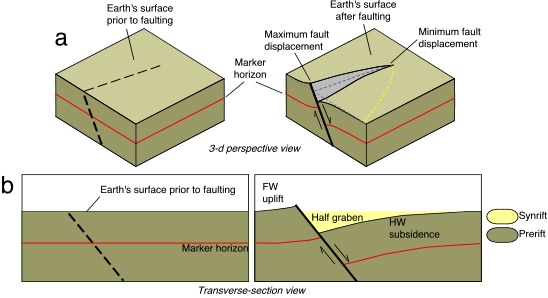
The photo is of the northern Sangre de Cristo mountains, on the eastern side of the Rio Grande Rift. The peaks are Precambrian igneous and metamorphic rocks, sillimanite grade and partially melted - I did my senior thesis research in the area. Further to the south, the Precambrian is covered by layers of sedimentary rock, all tilted towards the east, away from the fault. The range front is a normal fault, possibly still active. The valley is filled with sediments: lots of alluvial fan gravels, interbedded with lake sediments from wetter times. The western side of the valley is much less dramatic: hills of Tertiary volcanic rocks from the San Juan field are partially buried by the young gravels. Streams in the area feed an artesian groundwater system - as I drove across yesterday, I could see crusts of white minerals on the soil, left behind from evaporation of standing water. The Great Sand Dunes National Park is along the range front - the sand is carried into the valley by streams, and then blown back along the valley by the prevailing west winds. It's a particularly beautiful example of a half graben.
There was a session (that I missed, unfortunately) on groundwater and tectonics of the Rio Grande Rift. It focused more on the Albuquerque area (for good reason: there are a lot of people using that groundwater down there); the abstracts for the session are here.
I love that valley. High, open, dry. Snow-capped peaks. And a little bit of tectonics, where North America has been pulled a little bit apart, west of the plains and east of the Colorado Plateau.
Sunday, October 28, 2007
GSA: everyday science
There are stories about a session at the American Geophysical Union in 1966, when it finally became clear to the audience that sea-floor spreading was real and that the continents really did move. Apparently some other recent AGU meetings have had that sort of feel in sessions about climate change - Chris Mooney describes one in Storm World. But the Geological Society of America meetings that I've attended... they just haven't been like that.
Every talk is fifteen minutes long. Fifteen minutes, in which to make a case that one's ideas or data should change the way we interpret things. Fifteen minutes to convince a room of structural geologists that we really should start with equations of conservation of momentum, as Dave Pollard tried this afternoon. Fifteen minutes to try to explain why rotations determined from paleomagnetic data don't fit those predicted from estimates of strike-slip motion along Laramide structures. (If the model never fits the interpretations of the field data, something's got to be going on - either we don't understand the structures, or we don't understand what kind of rotation the structures should cause.) It's enough time to raise a few questions, maybe even to make a well-constructed argument... and then it's on to the next.
In part, it's the nature of science: most of what we do is incremental, fitting new data into existing models, tweaking the ideas here and there when the data don't quite fit with previous understanding. In part, it's the way the talks work: they are progress reports, ways to raise questions before submitting the long version of the research for rigorous peer review.
So what's the most interesting thing I saw today? Well, there was one talk (in a structure modeling session) testing a hypothesis for entraining layers of debris in the toe of a glacier... which concluded that, no, thrust faults couldn't form in a glacier. (It's nice to see someone come to a conclusion that, no, a model doesn't work.) And I learned, little by little, about mechanical modeling - but I didn't come away with the conclusion that my explanations for a certain group of structures have been totally wrong all this time.
My biggest conclusion for the day is that I need to do a better job of teaching quantitative skills in structural geology. Which isn't really a new conclusion at all.
But perhaps that is not so unsual.
And maybe, if I had wanted to have some paradigms shifted, I should have sat in the Mars sessions. (There will be another one tomorrow. I'm going to go, at least for a while.)
Friday, October 26, 2007
Pre-GSA Public Service Announcements
First, one future announcement: the Cutting Edge people are planning a follow-up session to the Teaching Structural Geology and Teaching Petrology workshops at the Rocky Mtn/Cordilleran Section GSA meeting (March 19-21 in Las Vegas). The abstract deadline in Dec. 11. The session isn't on the GSA website yet - look for it after the national meeting is
done. Oh, and there will probably be an associated field trip. I'm looking forward to the opportunity to discuss how to teach Cordilleran structure!
Now, about GSA...
Geoscience Educators Social Reception
Saturday, 27 October, 2007
5:00 - 7:00 pm
Colorado Convention Center, Hall F
Geobloggers dinner?
We tentatively planned to meet Sunday after the opening reception. I don't know the time or place. Sports bars may be rather crowded Sunday night...
World Series
If you've got a hotel room and a late plane flight, make sure to contact your hotel. Don't let your hotel room get given away to a baseball fan...
GSA. Be there.. or be a cricket fan, I guess. (I was going to say "or be a Yankees fan," but we can't all be originally from New England and currently from Colorado, and perfectly willing to switch allegiances depending on quality of the pitching on any given night. :D )
And with that, I've got a long but beautiful drive to make, and way too many exams to grade. Hope to see some of you in Denver.
Friday, September 28, 2007
Undergraduate research at GSA Cordilleran/Rocky Mtn meeting
A new theme session for next year's GSA Cordilleran/Rocky Mtn section meeting in Las Vegas has just been added: an undergraduate research poster session. If you teach undergraduates (or did research as an undergraduate), you may be used to these sessions - the Council on Undergraduate Research sponsors them every year.
This year, the Cordilleran/Rocky Mtn session got lost in the process of planning a joint meeting.
But it's scheduled now - Jeff Marshall (Cal Poly-Pomona) and Bill Dinklage (Utah Valley State College) will be co-convening it.
Abstract deadline is December 11. If you are an undergraduate doing research, or if you are a faculty member advising undergraduate research... well, I hope to see you there.